
Need help submitting the form?
If you're facing any issues, our team is ready to help you directly via WhatsApp or Email.
Dendara Temple — formally known as the Temple of Hathor — is one of the most remarkably preserved ancient religious complexes in the entire world. Located on the west bank of the Nile River in Upper Egypt, it has survived thousands of years of history in a condition that continues to astonish archaeologists, historians, and travellers alike.
Unlike many of Egypt's ancient monuments, which require significant imagination to picture in their original form, Dendara Temple still stands almost completely intact. Its towering hypostyle hall, its vivid astronomical ceiling, its crypt networks beneath the floors, and its rooftop shrines speak directly to the skill, devotion, and sophistication of the civilisation that built it.
For anyone travelling to Egypt — whether as a cultural explorer, a history enthusiast, or a curious first-time visitor — Dendara Temple represents one of the most rewarding experiences the country has to offer.
Dendara Temple is an ancient Egyptian religious complex located near Qena in Upper Egypt, dedicated primarily to Hathor, the goddess of love, beauty, and music. It is one of the best-preserved temple complexes in the ancient world, dating primarily from the Ptolemaic and early Roman periods. The site is renowned for its astronomical ceiling, intact hypostyle hall, rooftop shrines, and underground crypts.
Dendara Temple is situated near the modern town of Qena, approximately 60 kilometres north of Luxor in Upper Egypt. The site stands on the west bank of the Nile, at the edge of the cultivated floodplain where the desert begins — a location that held deep spiritual significance in ancient Egyptian thought, as the west was associated with the land of the dead and the divine realm.
The surrounding landscape is dramatic in its contrasts: the lush green strip of the Nile Valley on one side, and the bone-dry limestone escarpments of the Eastern Desert on the other. The temple complex itself is enclosed within a large mudbrick temenos wall — a sacred boundary — that separates the holy precinct from the outside world.
The nearest major city is Luxor, making Dendara Temple one of the most popular day trips from Luxor for visitors exploring Upper Egypt. The drive takes approximately one hour by road, passing through small agricultural villages and sugar cane fields along the Nile Valley.
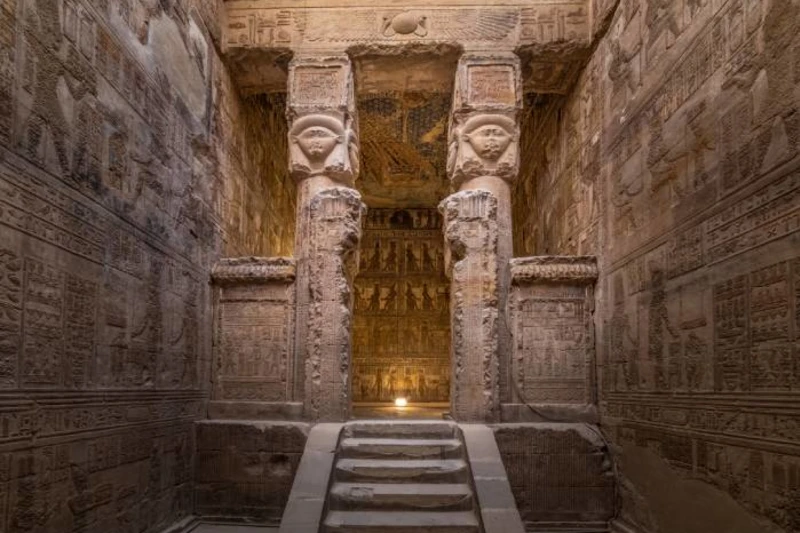
The site of Dendara has been a place of worship for far longer than the current temple structures suggest. Archaeological evidence indicates that religious activity at this site dates back to the Old Kingdom period, roughly 2,700 BCE — more than 4,500 years ago. Early shrines dedicated to Hathor, the goddess of love, beauty, music, motherhood, and joy, were constructed here long before the great temple complex visitors see today.
The ancient Egyptians referred to the site as Iunit or Tantere, and it served as the capital of the sixth nome (administrative district) of Upper Egypt for much of pharaonic history.
The temple complex that stands today was primarily built and expanded during the Ptolemaic Period (305–30 BCE) and the early Roman Period (30 BCE–14 CE). The foundations were laid during the reign of Ptolemy XII, the father of Cleopatra VII, and construction continued under several subsequent rulers including the Roman emperors Augustus and Tiberius, whose cartouches appear on the walls alongside those of the Egyptian pharaohs.
The temple was built as the primary cult temple of Hathor, one of the most widely worshipped deities in ancient Egypt. Hathor represented far more than love and beauty — she was the divine mother, the protector of women, the goddess of music and dance, the patroness of foreign lands, and a psychopomp who guided souls into the afterlife. She was also closely associated with the sun, the sky, and fertility.
The Ptolemaic rulers built on such an ancient and sacred site deliberately. By constructing a magnificent temple to a beloved Egyptian goddess, they demonstrated their respect for Egyptian religion and legitimised their rule over a people for whom religious continuity was fundamental to social order. This was temple-building as both devotion and political strategy.
Dendara Temple was not an isolated religious site. It was linked by sacred barque processions to the Temple of Horus at Edfu, located about 100 kilometres to the south. Once a year, during the Festival of the Beautiful Meeting, the cult statue of Hathor was transported by river from Dendara to Edfu, where she symbolically united with Horus in a ceremony representing the renewal of life and the cosmic order. This annual festival drew pilgrims from across Egypt and was one of the most celebrated religious events in the ancient calendar.
What makes Dendara Temple exceptional is its remarkable state of preservation. Unlike many ancient Egyptian temples that survive only as ruins, Dendara's main hall, roof, and underground crypts are largely intact. Its astronomical ceiling is one of the most detailed surviving examples of ancient Egyptian cosmology, and the painted reliefs throughout the complex retain much of their original colour.
The entrance to the main temple is through the great hypostyle hall, a vast columned space whose ceiling rests on 18 enormous columns, each topped with a four-faced capital bearing the head of Hathor. The ceiling here is decorated with spectacular astronomical scenes and painted in deep blue, gold, and ochre — colours that have retained their vibrancy to a degree that is frankly astonishing given their age.
One of the most celebrated features of Dendara Temple is its astronomical ceiling, which depicts the night sky as the ancient Egyptians understood it. This includes representations of the twelve signs of the zodiac — one of the earliest surviving zodiac charts in the world.
The original stone ceiling carving, known as the Dendara Zodiac, was removed by French archaeologists in 1820 and is now displayed in the Louvre Museum in Paris. A precise replica can be viewed in situ at the temple. The zodiac is considered a landmark in the history of astronomy and has been studied extensively by scholars of ancient science. The Louvre's catalogue entry provides further academic context for those wishing to learn more.
Beneath the floors of Dendara Temple lies an extraordinary network of crypts — narrow subterranean passages carved into the foundations of the building. These were used to store the temple's most sacred ritual objects, including statues of the gods that were only brought out during major festivals. The walls of the crypts are covered in exceptionally detailed relief carvings, some of which have remained in remarkable condition due to centuries of darkness and dry air.
A staircase within the temple leads to the rooftop, where a series of chapels dedicated to Osiris contain some of the most beautifully preserved painted reliefs in Egypt. These rooms were used during the annual resurrection ceremonies of Osiris and offer a direct view of the surrounding landscape from an elevated position. The combination of intimate painted chambers and sweeping Nile Valley views makes the rooftop one of the most memorable parts of the visit.
Within the temple enclosure, visitors can also see the remains of the sacred lake — a ritual body of water used for priestly purification — as well as a sanatorium where ancient pilgrims came to seek healing. Hathor's association with health and restoration made Dendara a site of pilgrimage for the sick and afflicted from across Egypt and beyond.
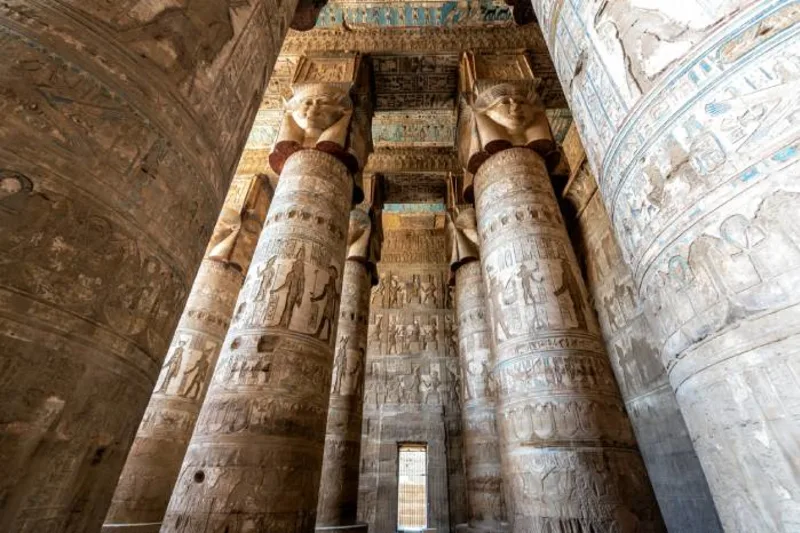
For ancient Egyptians, the Temple of Hathor was not merely a building — it was the literal house of the goddess on earth. Ritual life within the temple was constant and meticulously organised. Priests performed daily ceremonies to wash, dress, feed, and honour the cult statue of Hathor. Major festivals drew enormous crowds of worshippers. The temple was the spiritual and social heart of the entire region.
Dendara Temple is one of the most complete surviving examples of ancient Egyptian temple design. Because it was built relatively late in the pharaonic period and was quickly buried by desert sands following the decline of the old religion, much of its structure — including its roof — remained intact. This makes it invaluable to Egyptologists as a reference point for understanding temple ritual, cosmology, and religious art.
The UNESCO World Heritage designation of the Theban Necropolis and surrounding Upper Egypt sites reflects the international recognition of this region's extraordinary cultural importance, of which Dendara Temple is a key part.
Today, Dendara Temple is one of Egypt's premier archaeological attractions. It draws scholars, students, documentary filmmakers, and travellers from across the world.
It plays an important role in Egypt's cultural tourism economy and continues to yield new discoveries as ongoing conservation and excavation work reveals more of its ancient secrets.
Dendara Temple is most commonly visited as a day trip from Luxor. Organised tours typically combine it with the nearby Temple of Abydos, another extraordinary ancient site dedicated to Osiris, roughly 60 kilometres further north.
Together, these two temples make for one of the most rewarding single-day archaeological experiences in all of Egypt.
The site is managed by the Egyptian Ministry of Tourism and Antiquities. Entry tickets are available at the site, and guided tours are strongly recommended for visitors who want to fully understand what they are seeing. The Egypt Tourism Authority's official website provides up-to-date information on entry requirements, opening hours, and ticketing.
The best time to visit is early morning, both to avoid the midday heat and to see the painted ceilings in the best natural light conditions.
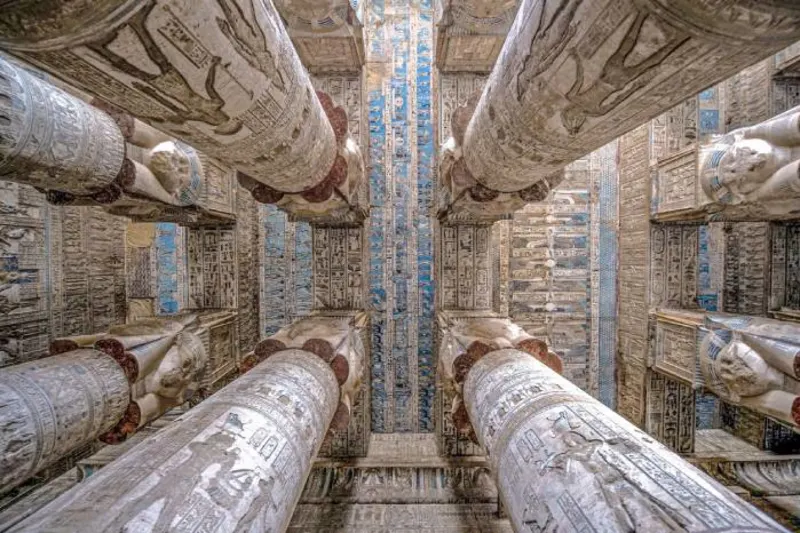
Dendara Temple endures as one of humanity's most extraordinary architectural and spiritual achievements. It is a place where ancient cosmology, religious devotion, political ambition, and artistic mastery converged to produce something that time has been unable to erase.
For travellers who want to understand Egypt beyond its most famous monuments, a visit to Dendara Temple is not simply recommended — it is essential.
Dendara Temple is located near the town of Qena on the west bank of the Nile River in Upper Egypt, approximately 60 kilometres north of Luxor. The surrounding region is part of the Nile Valley, flanked by desert escarpments, and the temple is set within a large mud-brick enclosure wall that marks the ancient sacred boundary of the site.
The main temple structures visible today were built primarily during the Ptolemaic Period (305–30 BCE), beginning under Ptolemy XII, and were continued and completed during the early Roman Period under emperors Augustus and Tiberius. However, the site itself has been a place of worship since the Old Kingdom, around 2,700 BCE, making its religious history over 4,500 years old.
Dendara Temple was built as the primary cult temple of Hathor, one of the most important goddesses in ancient Egyptian religion. Hathor was worshipped as the goddess of love, beauty, music, joy, motherhood, and the afterlife. The Ptolemaic rulers also built the temple to legitimise their rule over Egypt by demonstrating devotion to traditional Egyptian religious practices.
The Temple of Hathor at Dendara is the main temple within the Dendara complex and one of the largest and most complete ancient Egyptian temples still standing. It features an enormous hypostyle hall with Hathor-headed columns, an extraordinary painted astronomical ceiling depicting the Egyptian zodiac, rooftop Osiris chapels, and an underground network of crypts used to store sacred objects.
Dendara Temple is approximately 60 kilometres north of Luxor, which translates to about a one-hour drive by road. It is one of the most popular day trips from Luxor and is often combined with a visit to the Temple of Abydos, located further north, into a single full-day excursion.
The Dendara Zodiac is an ancient stone carving found on the ceiling of one of the Osiris chapels at Dendara Temple, depicting the twelve signs of the zodiac along with Egyptian constellations and astronomical figures. It is considered one of the oldest surviving zodiac charts in the world. The original was removed in 1820 and is now displayed in the Louvre Museum in Paris, while a replica is in place at the temple.
Yes, Dendara Temple is widely considered one of the most impressive and rewarding ancient sites in Egypt. Its extraordinary level of preservation, its vivid painted ceilings, and its complex religious architecture make it stand out even among Egypt's many famous monuments. Historians and archaeologists regard it as one of the most important reference sites for understanding ancient Egyptian temple religion.
The current structures at Dendara Temple were built mainly between approximately 54 BCE and 20 CE, making them roughly 2,000 to 2,100 years old. However, the sacred site itself has been in continuous religious use since at least 2,700 BCE, giving Dendara a history of worship spanning more than 4,500 years.
Yes. Visitors can enter the main hypostyle hall, walk through the inner sanctuary rooms, descend into the underground crypts (where permitted), and climb the internal staircase to the rooftop chapels. The interior is one of the highlights of the visit, with painted ceilings, detailed relief carvings, and dramatic scale. A guided tour is strongly recommended to fully understand the space.
Dendara Temple and the Temple of Horus at Edfu were ritually connected in ancient Egyptian religion. Once a year, during the Festival of the Beautiful Meeting, the cult statue of Hathor was transported by sacred boat from Dendara to Edfu, where she was symbolically reunited with Horus. This festival was one of the most important religious celebrations in ancient Egypt and attracted pilgrims from across the country.

Discover Egypt's hidden Nile on our Cairo & Dahabiya Nile cruise — El Kab, Gebel Silsila & Sheikh Rehan Island. Request your 8-day Egypt itinerary now!
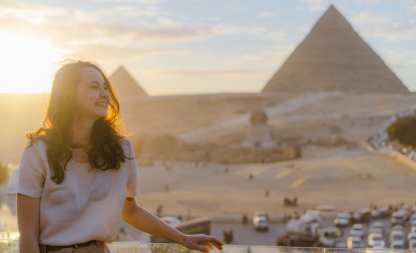
Cairo Luxor Tour: visit the Sphinx, Grand Egyptian Museum, Valley of Kings & Luxor Temple in 5 unforgettable days. request your tour now!

Don't miss Egypt Solar Eclipse Tour 2027 ! 9 days covering Cairo, Aswan, Luxor & Karnak totality. Expert guides & luxury cruise included. Request your place now!

The ultimate Egypt vacation: Cairo Pyramids, 5-star Nile Cruise, Luxor temples & 3 nights in Hurghada on the Red Sea. Private & guided. Request yours today!
If you're facing any issues, our team is ready to help you directly via WhatsApp or Email.





Copyright © 2026 Nile Cruise Vacation